Recipes by camera
Ricoh GR III & GR IIIx recipes
These are the Ricoh GR III recipes and GR IIIx recipes on the site (GR3 and GR3x, if that's how you searched), and every one of them runs on both bodies. The two cameras share identical menus and identical processing - the only difference is the lens, 28mm vs 40mm equivalent - so a recipe dialed in on one looks the same on the other.
New here? How to load a recipe on your camera · Want it on paper? Pocket cheat sheet (PDF)
72 recipes · most saved first
Bennet 800
by Bennet
Royal Supra
by Ritchie Roesch
Bennet's BW800
by Bennet
Portra 160
by Chrizz Ocampo
IAC Tri-X
by I Am a Camera
Candy Color 400
by Luke Taylor
Dante Sisofo Street B&W
by Dante Sisofo
Lux Pastel
by Robert Luxun
Leica Look
by Photo Stuff
Kodak Chrome
by Ritchie Roesch
KYO Night B&W
by Ricoh (GR official)
Classic Chrome... but Better
by Luke Taylor
Asakura Negative Film
by Ricoh (GR official)
Ninzaburo Monotone
by Ricoh (GR official)
Indigo Film 800
by Luke Taylor
1986 Negative
by Ritchie Roesch
Pro Color
by Ritchie Roesch
Travelog
by Ritchie Roesch
Dramatic Monochrome
by Ritchie Roesch
Kodamax
by Ritchie Roesch
Moody Monochrome
by Ritchie Roesch
Grotto 200
by Brendan Bullivant
Analog Film
by Ritchie Roesch
KodaKolor
by Ritchie Roesch
Pastel Film 400
by Luke Taylor
Americana Color
by Ritchie Roesch
Nostalgic Negative Film
by Chrizz Ocampo
Black & White Negative
by Ritchie Roesch
Cotton Color 400
by Luke Taylor
Ritchie's Positive Film
by Ritchie Roesch
Kodak Print
by Ritchie Roesch
Kodak Slide
by Ritchie Roesch
EktaColor
by Ritchie Roesch
EktaSlide
by Ritchie Roesch
Negative Film Gold
by Luke Taylor
B&W Negative + Red Filter
by Ritchie Roesch
Kodak Magenta Chrome
by Luke Taylor
Monochrome Film
by Ritchie Roesch
Vibrant Nostalgia
by Ritchie Roesch
Shady Summer Film
by Luke Taylor
Film Look
by Ritchie Roesch
B&W Film
by Ritchie Roesch
IAC Negative Film Gold
by I Am a Camera
Natural Analog
by Luke Taylor
Xpro Teal
by Ritchie Roesch
Ethereal Film 200
by Luke Taylor
Analog Film 400
by Luke Taylor
Analog Negative
by Luke Taylor
Chrome Slide
by Ritchie Roesch
Elite Chrome
by Ritchie Roesch
Vibrant Teal
by Ritchie Roesch
Warm Spring Evening
by Luke Taylor
Retro Chrome (1600)
by Luke Taylor
Vintage Film
by Ritchie Roesch
Aged Print
by Ritchie Roesch
Natural Negative
by Ritchie Roesch
Vibrant Analog
by Ritchie Roesch
Summer Green
by Ritchie Roesch
Blueberry Film 400
by Luke Taylor
Positive Emulsion
by Ritchie Roesch
Turquoise Film 200
by Luke Taylor
Vibrant Negative
by Ritchie Roesch
Color Film
by Ritchie Roesch
Ferrania Solaris
by Ritchie Roesch
Vintage Print
by Ritchie Roesch
Summer Bleach Film
by Luke Taylor
Ricoh HDR Film
by Luke Taylor
Retro Print
by Ritchie Roesch
Vintage Fade Film
by Luke Taylor
Aged & Faded
by Ritchie Roesch
Classic Emulsion
by Ritchie Roesch
Warm Negative
by Ritchie Roesch
About Ricoh GR III & GR IIIx
The settings are exactly what each creator published: image control, tone curve, white balance shift, grain. Save a recipe to a U1/U2/U3 slot once and it's a mode-dial turn away.
Moving to a GR IV later? Everything here carries over as a starting point - the values dial straight in, the IV just renders a touch warmer and brighter.
Before you load one: firmware
Two of the looks on this page did not exist when the GR III shipped. Negative Film arrived with firmware 1.70 on the GR III and 1.20 on the GR IIIx (January 2023), and Cross Processing with firmware 1.30 on the GR III (October 2019; the IIIx had it from launch). A used GR III on old firmware will not show those modes in the Image Control menu at all. The update is free from Ricoh, and the camera shows its version under Setup.
Grain also came by firmware (1.20 on the GR III) and lives on the four black and white modes only. A recipe that lists grain on a color mode is a GR IV recipe; on a III or IIIx that line is skipped.
What the GR III generation has
Twelve Image Controls plus two custom slots: Standard, Vivid, Positive Film, Negative Film, Bleach Bypass, Retro, Cross Processing, HDR Tone, and the four black and white modes (Monotone, Soft Monotone, Hard Monotone, Hi-Contrast B&W). The GR IV adds the two Cinema modes on top, which is why the Cinema recipes cannot be loaded here. Everything else, including every slider and the white balance shift, is the same menu on both generations.
The Image Control guide walks through what each mode and slider does; the save a recipe checklist has the GR III menu path for getting one onto U1, U2 or U3.
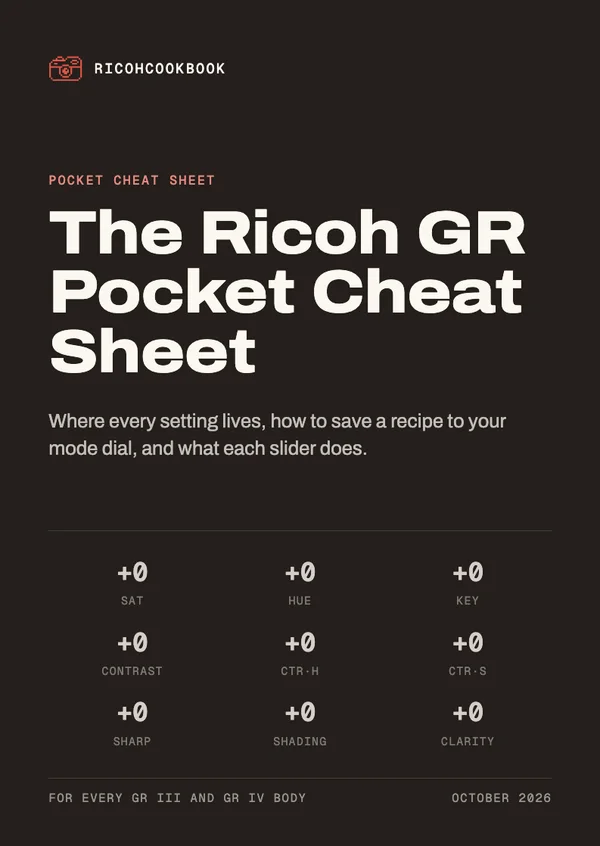
Get the GR Pocket Cheat Sheet
Pocket cards that explain every slider and walk you through saving a recipe on your camera. Sign up for the recipe emails and it's yours straight away.
Comes with the recipe emails: one when a recipe earns one. Unsubscribe anytime. Privacy